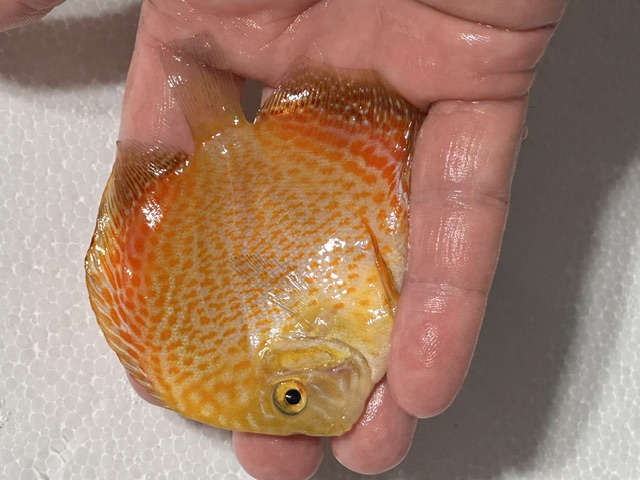
This the first installment of a new series of articles on how Flowerhorn are breed.
Sexing Flowerhorn is where we will start. It is very difficult to sex Flowerhorn less than 3 inches. Sometimes a male will start to grow the KOK (hump) early and if so if so it is probbable that it will be a male. Females at that size just really cannot be sexed at 3 inches or less.The only other techniques that can be used at that size is the males will grow slightly faster and will usually be the most dominant fish in a tank of baby Flowerhorn. With that said, there will be exceptions to both.
At somewhat around 4 inches males will start to develop the KOK (hump). The size of the KOK will vary drastically by the age and strain of the Floerhorn. Monster Hump Flowerhorn have the biggest KOK. The hump is made up of fluid and fatty tissue and will actually increase and decrease in size depending on the conditions. When spawning, it will slightly increase in size.
Males will also grow much longer streamers from both the Dorsal and Anal fins. Once again, this can vary significantly. Males will usually grow to a larger size than females, often significantly larger. Females will have a more robust, plump and rounded belly. When they become egg laden, this will become even more obvious. When mature female sexual organs will become apparent and are directly before the anal fin. This female organ is called an oviduct.
In females it will be a round opaque tube (for laying eggs). In a mature female Flowerhorn it will often be 1/16-1/8 inch long and about the width of a regular spaghetti noodle. Males will have a much smaller Urogenital Tube and it will also be
Growing out fry is easy. The Sawning Pair does all of the work for you. Discus fry eat the slime off the parent’s side for the first 10 days to three weeks. This slime is very high in protein and contains antibodies that help the babies fight off disease. Discus raised with the parents have a stronger immune system thatn those that are artificailly raised. When the fry become free swimming, they will instinctively go to the sides of the parents side to feed. They will change back and forth, usually in groups, between the male and female parents. They do not show any preference for the father or mother Discus. There is little more beautiful in the fish world than a pair of Discus Fish, in full spawning coloration, swimming with a school of small Discus Fry at their side.
There are some things you should remember. First, the fry will be small and weak, so you will want to turn off all filtration, except for a sponge filter. One of the biggest mistakes that you can make is to do any water change in this aquarium with water that is not EXACTLY the same temperature. Discus babies are extremely sensitive to temperature changes and will die if you do a water change with water that is more than a few degrees different in temperature. With that said, Discus Fry are also very sensitive to ammonia burn, so you will want to do daily partial water changes. We like to keep our grow out Discus tanks, until they reach about 1.5 inches, at a temperature of 88 degrees, as the high temperature does increase their metabolism and
In our last installment for breeding Discus we went over how to raise the fry artificially. We will now go over raising the fry naturally as Discus do in the Wild. Then we will go over growing out the baby Discus to be healthy and grow fast.
Growing out the Discus babies requires very little work on your part. The breeder pair will do all of the work for you. One problem is that it is very common for the parents to eat the babies. If your pair easts the fry you should consider artificially raise the fry. There are advantages to naturally raising the fry over and above that it is much easier. Discus fry eat the slime off the parent’s side for the first 10-30 days. This slime is very high in protein and contains disease resistant antibodies that help the fry fight off diseases, particularily bacterial infections. Naturally raised fry will grow much faster at first and will have much more resistance to disease throughout their lives.
Once the fry get to the point where they are free swimming, they will instinctively go to the sides of both of the parents to feed. They will go back and forth, usually in groups between the male and female breeder pair. They do not show a preference for father or mother, but the male is more likely to eat them. There is nothing more beautiful in the fish world than a pair of Discus, in full spawning coloration, swimming with a school of small babies at their side.
There are things you should remember. First, the fry will be very small and weak, so you will need to turn off all filtration, except for a sponge filter. The biggest mistake that you can make is to do a water
We went over your options with raising the new fry once they become free swimming in our last post. We will now go over how to artificially raise the fry. In the next Post we will go over raising the fry naturally.
The keys to artificially raising the fry, which is what you have been waiting to read, are below. This is where the few who have gotten to this point successfully will usually fail. It is very important that you do everything below and do not leave anything out or take shortcuts. Artificially raising the fry is difficult and time consuming, but only those that are willing to do everything will succeed.
There are two keys to raising the fry artificially: Cleanliness is one of the key things to do and changing the water with water that is the same temperature is the other key.
Step 1: Use a 1 gallon glass jar or beaker, fill it with the tank water the parents (& eggs) tank. Then put the eggs, and what they were laid on, into the jar. Step 2: Place the jar in a 5 gallon tank filled with water at 84f (50w heater is required). Also put a Sponge Filter in the 5 gallon tank and turn it on. This will keep the jar warm and allow the tank to cycle. I always have filters in my 5 gallon tank so they are cycled. Step 3: Add an air stone or bubbler to the jar. Turn it on medium so that there is a good current in the jar. Step 4: Add three drops of methylene blue. Three drops will work well and allows you to observe the eggs. Step 5: The eggs will begin hatching in two days. Step 6: They will become free swimming
Previously we detailed Discus fry prior to them being free swimming. Now we will go over what to do once they become free swimming. At the next article, we will go over Discus fry after they become free swimming.
Now the most difficult part of Discus breeding starts. This is where the few individuals have gotten to this point successfully will usually fail. You now have to make a an important decision. Do you let the Discus raise their own fry naturally or do you take the Discus fry out and artificially raise them. There are advantages and disadvantages no matter which way you decide to go. We will briefly discuss the advantages and disadvantages of both methods.
The biggest advantage to letting the Discus raise their own fry is that it is MUCH less work. Other than keeping the water ultra clean via water changes, as you will not be able to run any filters except a sponge filter, there is not much to be done differently to what you normally do in keeping the fish. There is another advantage to naturally raising the fry that most people tend to forget. Fry that feed off the natural slime of the parents Discus receive antibodies from their parents, thereby making them much more resistant to disease later in their life. On the other side, the large disadvantage is that the parents will eat the fry the vast majority of the time. They will do it very quickly in just a few minutes, you will not know they are eating them and there is really nothing you can do to prevent it.
Conversely, the advantages and disadvantages to artificially raising the Discus fry is just the opposite. There will be three weeks of caring for your fry every few hours, 24
Previously we went over Discus fertility. We will now go over the fry prior to them becoming free swimming. Next we will go over fry once they become free swimming.
This is the easiest part of spawning and is also one of the most fascinating. If only it could all be this much fun.
After 48 – 72 hours, depending mainly on the tank water temperature, the eggs will begin to hatch. Only the dark ones will hatch. Any that are white are infertile and will not hatch. The fertile ones are dark because after about 36 hours, the eye starts to develop and will show through the egg sack. Most of the fry will stay attached to the surface where the eggs were laid via a small membrane on their head. A few will become detached and will fall to the bottom. At this point the fry will look like a small comma to the naked eye. Under magnification, they are quite ugly and will look like something straight out of a monster movie. You should take the time to look at them under magnification, because it is hard to believe that such a beautiful fish can come from such an ugly baby.
They will remain attached to the substrate for another 48 to 72 hours. There is not much to do at this point. It can be fun to watch their shape evolve. They will have an egg sack and will live off of it during this entire time. There are only two real concerns. The first is the parents eating them. If you are going to artificially raise the fry, you will want to take the parents out. If you are not going to artificially raise the fry, you should cover them with a screen. Sofit screens work
We have gone over the problem of Discus eating their eggs while spawning or shortly thereafter in a previous posting. Now we will go over fertility. We will go over what happens once the eggs hatch, but before the fry are free swimming next.
Fertility is an issue with Discus Fish and will significantly vary between different pairs. Some pairs will be totally infertile; other pairs will be infertile at first and then will become less fertile over time. On pairs that are fertile, the percentage of fertile eggs will range from 10%, in this scenario, about 80% fertility.
There are three typical causes of infertility for Discus. The first one is caused by the male not doing his job and not fertilizing the eggs. The second and third are biological and are due to either the eggs or sperm being genetically or chemically infertile.
When Discus lay eggs, the male should follow the female on a fertilizing run after she does an egg laying run. Some males only make the run after every few egg laying runs. It is my experience that these males tend to have a lower fertility rate. Some males will not fertilize at all. These tend to be the males that also are most aggressive on eating the eggs. There is very little you can do to change these males.
Some Discus Fish are infertile because of water chemistry. To optimize fertility, water temps should be kept constant between 84 and 88 degrees. Ph should be kept constant at 6.5. TDS should be low at 18 or less. Heavy filtration, if possible, is a big plus. I try and avoid doing water changes when they have spawned.
Discus that are genetically infertile will never be fertile. Keeping water temperatures above 96 degrees for over a
We will now go over what you can expect after the eggs have been laid on the breeding surface by the female Discus. This is where the frustration starts. The first two issues that you must overcome are the parents eating of the eggs, especially by the male. You will also have to deal with infertility. We will go over the eating of the eggs first. We will go over fertility in the part 4 of the series.
The number one problem, and the one you must get past, with breeding Discus is the eating of the eggs by the parents. While both parents will eat the eggs, the male does it more often. This is often done as they spawn with the male following the female as she lays the eggs and then the male immediately eats the eggs. There is very little you can do if this occurs while spawning. The female will make her egg-laying run and then the male, instead of following her with a fertilizing run, will follow her and eat the row of eggs. This behavior is very common in new breeding pairs of Discus. A majority of new Discus pairs will eat their eggs. Fortunately, they will often stop this behavior as they become a more mature spawning pair. If you get lucky and they do not eat their eggs when spawning, there is a very good chance that they will eat them before they hatch. The good news is, if you get this far, there is something you can do. You can take the eggs out and artificially raise them or you can take a mesh screen (house soffit screen works very well) and fit it directly over the eggs. This will allow the Discus to still blow on the eggs and
The spawning process is the best part of breeding Discus. This has always been my favorite part of Discus keeping and I still, 40 years after my first Discus spawn, find it fascinating.
The first indication that your Discus are getting ready to spawn will be their obsession with cleaning a rock, breeding cone, filter tube or side of the aquarium. Once you see both of them doing this, spawning will usually follow within a couple of days. You will soon see them start to do the mating dance. They will swim towards each other at a slightly upward angle. Once they get next to each other, they will shimmy and then swim away from each other at a slightly lowered angle. The most spectacular part of the spawning process will be the colors of your Discus. Whatever their color prior to spawning, it will become MUCH more intense and vibrant during spawning. This will be the most beautiful you will ever see your Discus. They will also become aggressive toward other fish, including Discus, at this time. They will aggressively chase away other fish from the breeding site from all intruders, including you. The male Discus will be the one that is most aggressive.
After your Discus start doing all of the above, they will actually start laying the eggs. It will begin with the female rubbing her belly, and her breeding tube, against the surface that they have cleaned. She will always lay in an upwards motion. The total length of the spawning run will be between ½ and three inches. Some Discus will have extremely orderly patterns of laying the eggs. Others will look haphazard. She will lay between 1 and 12 eggs per spawning run. The male Discus will usually then follow directly behind her in
What you need to understand is that you are not in total control. If Discus do not want to pair off, they are not going to pair off and there is nothing you can do about it. What you can do is provide the right conditions so that it is more likely that they will pair off.
If you have a sexed pair of Discus in a tank by themselves, there is an approximately 70% chance that they will eventually pair off if left together for a long period of time.
To encourage the potential young lover Discus along, provide conditions that are conducive for fishy love. We put seven mature Discus in a 125-gallon tank and let them acclimate to it for two weeks. We then start doing sudden changes in the tank conditions to encourage courtship. Some of the changes we make are
Change the water temperature to 76 degrees for a few days and then bring it up to 88 degrees over about 12 hours and then leave it at 88 degrees for a week. Let the tank get somewhat dirty by not doing the daily water changes for a week and then doing an 80% water change. Feed your potential breeder Discus heavily for three days and then stop feeding them for two days, followed by feeding them live food for three days. Do two 60% water changes six hours apart where the Ph goes from 6.4 to 7.0 at the first change and then from 7.0 to 7.6 at the second change. Leave the tank totally dark for two days and then turn the lights on for two days.
If you have tried all of the above and after two months your Discus still have not paired off, we switch out three of those Discus