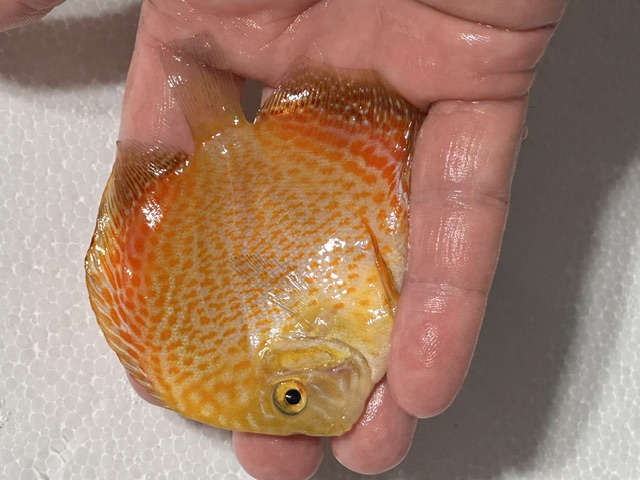
The Super Red Marlboro was one of the first Pigeon Blood derived strains. The Red Melon and the Red Marlboro look very similar. The main difference being that the Red Marlboro often, but not always, has some patterning in the fins. 15 years ago it would have likely had quite a bit of peppering, even if not stressed. The ones we sell today have very little to no peppering and when they do it is mostly temporary/transient peppering that will go away when the fish are not stressed. Super Red Marlboros can come in three different color options, the White Faced Red Marlboro, the Red Faced Red Marlboro and the Yellow Faced Red Marlboro. As juveniles, Super Red Marlboros often do not show their full coloration and usually only show the red coloration in patches across the body and in the fins. As they mature, these patches will fill in.
Pigeon Blood Discus were originally developed from a mutation found in a Red Turquoise Discus in 1989. Kitti Phanaithi, a breeder of Discus since 1970 in Thailand, saw a Discus in a friends tank that had a very yellow and golden sheen in the coloration. It also had considerable black coloration in the fins and a little on the body. It had extremely bright yellow eyes. Kitti recognized that this was probably a naturally occurring mutation and purchased the Discus for 3000.00 USD. He then selectively crossbred it with other Red Turquoise Discus to develop the Pigeon Blood strain. Kitti first showed the Discus to the world at the 1991 Aquarama in Singapore.
Most of the brightly colored yellow, gold, orange and light red Discus are Pigeon Blood derived strains. As mentioned previously, some of these are the Red Melon, Fire Dragon, Siam Yellow Master, Golden Sunrise. Recently, more
While we do not sell the Pigeon Blood Discus, many of the strains we do sell are derived from the original Pigeon Blood Discus. Some of these strains are the Red Melon, Fire Dragon, Siam Yellow Master, Golden Sunrise and others.
Pigeon Blood Discus were originally developed from a mutation found in a Red Turquoise Discus in 1989. Kitti Phanaithi, a breeder of Discus since 1970 in Thailand, saw a Discus in a friends tank that had a very yellow and golden sheen in the coloration. It also had considerable black coloration in the fins and a little on the body. It had extremely bright yellow eyes. Kitti recognized that this was probably a naturally occurring mutation and purchased the Discus for 3000.00 USD. He then selectively crossbred it with other Red Turquoise Discus to develop the Pigeon Blood strain. Kitti first showed the Discus to the world at the 1991 Aquarama in Singapore.
Most of the brightly colored yellow, gold, orange and light red Discus are Pigeon Blood derived strains. As mentioned previously, some of these are the Red Melon, Fire Dragon, Siam Yellow Master, Golden Sunrise. Recently, more strains of different coloration such as light blues and white (Snow White Discus are not derived from Pigeon Blood) have been developed. About 10 years ago, Pigeon Blood Discus with bright red eyes were developed. At first, most of the Pigeon Blood derived Discus still had the black “peppering” on most of the fins and some of the body. Over the last 20 years, since the Pigeon Blood was first developed, highly selective breeding has been successful in getting rid of most of the black peppering. With that said, many of the pigeon blood strains will show a little black peppering. The black peppering will increase dramatically when these Discus
Previously, we discussed how to raise the Flowerhorn fry. Now we will review how to grow out and raise the Flowerhorn fry. This will the last post in our series on how to breed Flowerhorn.
Flowerhorn have large spawns and there usually is 100 to 600 eggs, so you will need at least a 10 gallon tank to start the fry raising process. We recommend that the tank set up be simple, a 10 gallon tank, a submersible heater with thermostat and a sponge filter. That’s it.
Flowerhorn grow very fast. If kept in the proper conditions, they can reach the one inch size in two to three months. As they grow, you will want to move them into a 20 gallon tank or spread them out over several tanks. Flowerhorn are very aggressive, but can be kept together in large holding tanks until they grow to three inches. At that time, we move them into 20 gallon individual grow out tanks with about 10 in each tank.. When you keep 10 Flowerhorn or more in tanks to grow out, it is important to add lots of distractions and hiding places. For distraction, we will put three strong bubblers in the tank, The water currents keep them distracted as they have to constantly swim to move with the current and the exercise helps them to grow faster. To make lots of hiding places, we will add in eight 3 inch elbow PCV pipe fittings. These work good as they stay will be stable on the bottom and as there is a 90 degree angle, a bully Flowerhorn cannot see one hiding on the other end of the PCV tubing.
Food is very important. We feed the fry 4 times a day, as much as they can eat in 5 minutes.
Previously we discussed the hatching of the Flowerhorn eggs. Now we will go over how to raise the fry. Soon we will go over how to grow out the Babies.
Flowerhorn have large Spawns and there can be 200 to 600 eggs, so you will need a 10 gallon or larger tank to start the Flowerhorn fry raising process. We recommend that the set up be pretty simple, a 10 gallon tank, a submersible heater with thermostat and a sponge filter. That’s it.
Flowerhorn fry are extremely hardy compared to Angelfish and Discus fry. You do not need to worry much about the water conditions such as Ph and Gh. TDS should be inder 200. It is important that you keep the water very warm, around 82 degrees, to stimulate growth and appetite. You will also need to make sure that there is no ammonia build up in the rearing tank. On a daily basis, for the first two weeks, you will need to do partial 50% water changes. The best way to do this is using an airline as the siphon and very slowly sucking up the food on the bottom, making sure you do not also suck up the fry. We run the airline into a net over a bucket, so that if you suck up any of the fry, you can recover them. When the food is gone, you use a larger frexible tube to suck up more water that is away from the babies.
The Flowerhorn Fry will start to become free swimming at about 2 to 3 days after them hatching. Flowerhorn fry, while small, are larger than many other Cichlid fry. This is a huge advantage, as compared to other Cichlids such as a Discus and Angelfish, as they can eat larger food. Newly
Previously we went over the behavior after the spawn. We will now go over the hatching of the eggs. Next we will go over how to raise and take care the fry.
Flowerhorn have large pawns and there can be more than 600 eggs.
After 72 hours, depending mainly on the temperature of the water, the eggs will begin to hatch out. If the turn white, that means they are not fertilized and will not hatch. Only the dark ones will hatch. They are dark because after around 36 hours, the eye starts to develop inside the egg and will show through the egg sack. Most of the fry will stay attached to the surface where the eggs were laid via a small membrane on the top of the head. A few often become detached from the surface they were attached to and will fall to the bottom of the tank. At this point the fry will look like a small comma to the naked eye. Under magnification, they are extremely ugly and will look like something straight out of a monster movie.
They will remain attached to the substrate for another 72 hours. They will have an egg sack and will live off of it until they become free swimming. The main concern unitl they become free swimming is fungus will start to grow on them and kill them. Adding Methylene Blue to the water will kill the fungus. If you are going to artificially raise them, and have taken the parents out of the tank, you should add strong aeration about one inch from the fry to keep the water moving around them. They will start to become free swimming about 3 to 4 days after hatching.
In our previous artical we went over the Flowerhorn spawning process. Next, we will go over Flowerhorn behavior after the they spawn.
The great news is that Flowerhorn, unlike many other species of cichlid, will usually not eat their eggs. With that said, they will display several post spawn activities that many other Cichlids display. The female Flowerhorn will take up a position above the eggs and will mouth the eggs continuosly. The purpose of the female Flowerhorn mouthing the eggs is to get rid of any eggs that are infertile and to keep fungus from forming on the eggs. She will defend the eggs with her life. If you are brave enough to put your hand in the tank somewhere near the eggs, she will viciously attack it (and it can hurt). Much of the time she will drive the male away from being around the eggs, but not always. The amount of aggression betwen the couple can vary significantly between different pairs of Flowerhorn. The male will usually stay somewaht near the eggs guarding against any other threats such as other fish, but will not be so close as to irritte the female. If you put your hand anywhere in the tank, even on the other end, the male Flowerhorn will attack it. While the male and female will show some aggressive behavior towards each other, they will not usually do any actual damage to each other while the eggs are viable. Once the eggs hatch out, that can change and the male will sometimes kill the female. We recommend that you take the female out before the Flowerhorn fry become free swimming.
Prviously we went over getting a pair to spawn, we will go over the actual spawn.
One of the first sign that your Flowerhorn are preparing to spawn is that the Flowerhorn will begin to clear off a surface in the tank. Often they will clean of the bottom of the tank, which makes removing the eggs and raising them artificially impossible. Flowerhorn can lay up to 500 eggs in one spawn and that requires a surface that is about 8 inches square. Before the spawning the male will have been the dominant fish. During the entire spawn process and while the fry are not yet free swimming, the roles will reverse and the female will become dominant. She will act aggressively to the male and often will do “Lip Locking” with the male which looks like a sign of courtship. Lip Locking is not a sign off affection such as in kissing. Rather, it is acutally a sign of aggression in the courtship. Unlike many other Cichlids, Discus for example, they will do very little in the way of a spawning “Dance”. At some point the female Flowerhorn will try to steer the male to the area that will be the spawning surface. The spawning process actually starts when she begins laying the eggs. She will usueally lay them in rows of 10 –30 eggs. The male will usually follow behind her, often every time she lays eggs and at other times after every 2nd, 3rd or 4th laying run, and fertilize the eggs. After the spawn is complete, the female will stay directly above the eggs and the male will stay on the periphery of the eggs and guard against all intruders. If you put your hand in the tank, it will be viciously attacked.
We went over breeding tank set up previously, we will now go over getting a Flowerhorn pair. The secrets to getting Flowerhorn to pair off and spawn are pretty much the same as other Cichlids. Once they go into pre spawning activities, the bullying will decrease, but very rough mating will start. The most effective technique that works the best can be hard for many aquarist to do, because it goes against everything we try to accomplish with our aquariums. But with that said, it works and does not hurt your Flowerhorn in the long run.
The best way to get a pair of Flowerhorn to spawn is to let their aquarium conditions deteriorate and become very poor for about one to two weeks. This should include, taking the filter pads out of the filters and running them without the pads (they need to run to keep the water circulating), letting some algae build up in the aquarium and letting the water level of the aquarium get low, to about 3/4 full. Please make sure that you leave aeration in the tank so the water does not become oxygen deficient. We also recommend that you feed them around ½ the normal amount during this time. Once the conditions in the aquarium have deteriorated to the point where it is becoming stressful to the Flowerhorn, do a complete water change and cleaning of the tank. Typically, most pairs will spawn within a few days (often within hours) of the completion of the cleaning.
Other techniques are:
• Change the water temperature to 72 degrees for a few days and then slowely bring it up to 82 degrees over about 12 hours and then leave it at 82 degrees for the remainder of a week.
A month ago we went over how to keep a Fowerhorn pair, now we will go over the breeding tank set up.
One of the first things to be aware of is that mature Flowerhorn are very strong and no matter what you do, they will completely rearrange the breeding tank when they spawn. As a part of the pre spawn courtship, they will move, pile, re-move and then pile again any rocks, gravel, driftwood in the tank. They like to spawn on flat, horizontal surfaces. Slate works best. I place several large pieces of slate to lay flat on the bottom of the tank. Flowerhorn will lay up to a thousand eggs just at one spawning, so you will need the pieces of slate to be at least 8 inches x 8 inches.
They often choose to remove most everything from part of the bottom of the aquarium and lay the eggs directly on the bottom glass of the tank.
Just prior to spawning, the male often will attack and hurt the female. Then once they start spawning, they will often get along fine. After spawning, the female will become very protective of the eggs and I have seen the female actually beat up and kill a male that just days before was attacking her. I go over this so you will know that it is very, very important for you to have plenty of hiding places in the tank during the entire breeding process. I put several 8 inch pieces of PCV pipe in the tank that are large enough for the female to go into, but small enough that the male, who is almost always larger, cannot go into. This can be easily accomplished as PCV piping is sold in 2, 3, 4 and 6 inch diameter
At the last posting we went over how to sex Flowerhorn, in this post we will go over how to keep a Flowerhorn pair.
Sexing Flowerhorn is not the end, it is actually just the start of the most difficult part of breeding Flowerhorn. The biggest difficulty with breeding Flowerhorn is that the male will be very aggressive with the female and somethimes will kill the female, occasionally within hours of putting them together. Male Flowerhorn can be relentless in attacking females (and other males). The good news is that there are several ways to deal with this problem:
• Sometimes you will get a breeding pair of Flowerhorn that are not overly aggressive towards each other. While this is rare, it can happen, and if you do get one of these pairs, you should count your blessings. • The most effective way to get a Flowerhorn pair that will be good together is to plan well in advance. If you buy 6-10 Flowerhorn at a very small size, usually they will grow up without becoming fatally aggressive. They will still be very aggressive, but most of the time none get actually killed. The aggressiveness will start around 3 inches, so make sure you have many, many hiding places. Usually, the largest male Flowerhorn will pair off with the largest female Flowerhorn when they become mature. This breeding pair can then be kept in a separate tank together. Once again, while they will not kill each other, they will still be very aggressive, especially between spawnings, so please make sure there are plenty of hiding places. Often when you keep the ones left in a large tank, another Flowerhorn pair will separate out after you take out the first pair. • Another trick is to keep them in a tank