Gourmet Pleco Flake is the absolute best food you can feed your Plecos. Gourmet Pleco Flake from www.SOMETHINGSPHISHY.com is not just Spirulina or Algae Flake. It has powdered wood shavings in it as mostly unique to Plecos they do need some wood in their diet. In the wild many Plecos, especially Royal Plecos, eat insects on and in the wood in the water and naturally get a lot of wood in their diet. Over time the wood became not just incidental to their health, but a necessity. Our Gourmet Pleco Flake also contains fish meal. Once again, many Plecos eat insects on wood in the wild and the fish meal provides the protein that they get from the insects in the rivers of the Amazon.
Please go to SomethingsPhishy to buy the Gourmet Pleco Flake and Gourmet Pleco Wafers.
You can buy Plecos, Angelfish, GloFish, Exotic Tropical Fish and Discus Fish for Sale at www.SOMETHINGSPHISHY.com
Somethingsphishy UPS differences between UPS Next Day Air and UPS Next Day Air Saver
UPS Next Day Air Saver® https://www.ups.com/content/us/en/shipping/time/service/next_day_saver.html?WT.svl=SubNav
Choose this guaranteed next-day service when afternoon delivery meets your needsDelivery Commitment Commercial Destinations:Next business day delivery by 3:00 or 4:30 p.m. where UPS Next Day Air® delivery is committed by 10:30 a.m. or 12:00 noon, respectively
Residential Destinations:Next business day delivery by end of day
UPS Next Day Air®https://www.ups.com/content/us/en/shipping/time/service/next_day.html?WT.svl=SubNavDelivery Commitment Next business day delivery by 10:30 a.m.,12:00 noon, or end of day, depending ondestination
Earthworm Shrimp Flake is another one of our favorite foods to give your Discus Fish and Angelfish a variety. We have found that the taste of the Earthworm Flake is especially tasty to large Discus around 5 inches or larger. Fish do best when given a variety of foods. Feeding your Discus Fish many protein-rich foods is essential for their health, growth, vibrant coloration and longevity . Once your fish get used to it, they will aggresively eat it. You can float it on the top of the water, but I still get joy when they eat it right from my fingers. My personal Discus follow me back and forth across the tank everytime I walk through the room.
Earthworm Flake from www.somethingsphishy.com provides a convenient food that is high in protein, fiber, vitamins and minerals, and that is a great for your fish health. They absolutely love to eat it. Earthworm Flake has a nutritional content of:
Earthworm Flake from Somethingsphishy are fortified with Vitamins and Minerals to ensure a complete and balanced diet. You can buy our Earthworm Flake at this Link: SomethingsPhishy Fish Food.
Brine Shrimp Flake is one of our favorite foods to give your Discus Fish and Angelfish a variety of foods. Fish thrive when given a variety of foods. Feeding Discus Fish multiple protein-rich foods is essential for their health, growth, and vibrant coloration. Brine Shrimp Flakes from www.somethingsphishy.com provides a convenient food that is high in vitamins and minerals that is a great for your fish health and they absolutely love to eat it. Brine Shrimp Flake is exceptionally high in quality protein (over 48%) and fat (10%). Brine Shrimp Flake from Somethingsphishy are fortified with Vitamins and Minerals to ensure a complete and balanced diet. You can buy our Brine Shrimp Flake at this Link: SomethingsPhishy Fish Food. It can taint the water a little red, so it should be fed in a smaller than normal amount.
Feeding Discus Fish a high-quality, protein-rich diet is essential for their health, growth, and vibrant coloration. Beef Heart Flakes from www.somethingsphishy.com provide a convenient, nutritionally dense option that addresses these needs effectively. Beef Heart is exceptionally high in quality protein (over 45%) and all essential amino acids, which are crucial for the development of healthy, robust Discus, especially juveniles. This high protein content is a primary reason breeders have long favored Beef Heart in their feeding regimens. Beef Heart Flakes from Somethingsphishy are fortified with Vitamins and Minerals to ensure a balanced diet. One last important quality of our Beef Heart Flake is they do not foul or color the water as ground raw Beef Heart and many other Flakes are prone to do. You can buy our Beef Heart Flake at this Link: SomethingsPhishy Fish Food. We recommed you feed your Discus three times daily and Beef Heart Flake should be used for at least one of those feeding. You can find it on the same page with all of our Discus Fish for Sale.
To ensure your baby discus thrive during the “growing out” phase after the first month, here are the key steps, incorporating and building upon the information you’ve already outlined: Growing Out the Baby Discus Once your discus fry reach approximately ½ inch in size (around one month old) and are exclusively eating baby brine shrimp, you are in the growing-out stage. The goal now shifts from protective nurturing to maximizing growth through high-quality nutrition and pristine water conditions. 1. Transitioning Diet From Brine Shrimp to Solid Foods: Continue feeding live baby brine shrimp for a few more weeks as they are an excellent, high-protein food source. Gradually introduce finely crushed, high-quality flake food or a specialized commercial discus granular food. Frequency: Feed small amounts frequently—ideally 5 to 6 times per day. Young discus have high metabolisms and require constant nutrition to grow quickly. Variety: Introduce variety with a quality frozen mix (like a beef heart blend, mysis shrimp, or bloodworms) finely minced. A varied diet ensures they receive all necessary nutrients. 2. Water Management (The “Growing Out” Key) Water quality becomes paramount for rapid, healthy growth. Daily Water Changes are Crucial: You correctly noted the sensitivity of young fry to ammonia. As they grow and eat more, they produce significantly more waste. Daily partial water changes (50% or more) are mandatory. Strive for water parameters as close to ideal as possible. Temperature Control: While they are hardier now, maintaining stable water temperature (around 82°F to 86°F or 28°C to 30°C) is essential. Continue to ensure that any replacement water is exactly the same temperature as the tank water to prevent shock. Filtration Upgrade: The gentle sponge filter used for the tiny fry can now be supplemented or
Bullying by Discus amongst each other is very common and should be expected and planned around.
Discus bully other Discus for mainly one reason, to establish a pecking order. It can take months to establish a pecking order, but once it is established the bullying usually lessens. The most aggressive bullying usually happens amongst larger Discus that are close in size and age. It is not always the largest that wins the top of the pecking order. Sometimes a Discus that is slightly smaller is just more aggressive and can be above another Discus that is slightly bigger. It is not always the males that are on the top. I have had many times had the female being bigger bullies that similar sized males.
The only other reason for bullying is when to have pair are spawning or are preparing to spawn. The pair will almost always chase all of the other Discus to the other end of the tank and will be relentless. The male will be the most aggressive. The upside is that Discus will have their best coloration that they will ever have during the spawning.
The good news is that Discus almost never bully another Discus to the point that it kills the Discus being bullied. With that said, it can be hard watch is not wanted in the aquarium.
There is nothing you can do to stop the bullying. There are some tricks that do work to lessen it. Distractions are the main tool to lessen bullying. I have found the most effective way to reduce bullying is to have large schools of very brightly colored fish in the tank. My main go to is Neon Tetras. Adding several bubblers will also create distractions.
Hiding places are another necessary tool. Large rock formation, driftwood and/
The German Blue Ram is a beautiful but sensitive freshwater tropical fish requiring warm water, proper and appropriate diet and peaceful tank mates for best health and longevity. They are great tankmates for Discus Fish and Angelfish. They come from the same rivers in the Amazon Basin as do Discus Fish and Angelfish.
Tank Setup and Water Parameters
Tank Size: Minimum of 20 gallons for a pair or trio to ensure ample swimming space and reduce territorial stress . Temperature: Maintain between 78°F and 86°F (25°C to 29°C). Stable warmth is crucial as sudden drops harm them . pH: Ideally 6.0 to 7.5, often slightly acidic (6.0-6.5) mimicking their native slow-moving, tannin-rich South American waters . Water Hardness: Soft to moderately hard water, with a TDS under 250. Filtration & Flow: Use gentle filtration with slow water flow since they come from calm waters; biological filtration is essential to maintain pristine water quality . Substrate: Medium or soft substrate is recommended as they sift the substrate for food . Avoid sharp gravel that can injure them. Important: Avoid over-crowding the tank.
Diet and Feeding
German Blue Rams are omnivores: feed a varied diet including high-quality sinking pellets or flakes designed to provide a variety of animal and plants nutrition. Freeze Dried Bloodworms, Tubifex, , Brine Shrimp (live, frozen and freeze dried) and Daphnia. Feed 2-3 small meals per day, only as much as they consume in 10 minutes to avoid overfeeding and maintain water quality. They can be picky when first introduced, so frozen/live food often encourages feeding.
Behavior and Tank Mates
German Blue Rams are generally peaceful but can territorial among themselves, especially during breeding. They thrive in community tanks with other small, peaceful fish that share similar water requirements, including various tetras (Neon, Cardinal, Rummy-Nose), Corydoras catfish, smaller Gouramis, and Plecos. They also do great with Discus Fish and Angelfish.
Discus fish growth rates are influenced by many different factors. The main factor is keeping them healthy in a very clean aquarium. If any of your fish get sick at all the growth will stop until they get healthy again. Growth will also slow down or stop if they are stressed out from an aquarium with non-optimal water conditions. Choosing a high protein diet that the fish will happily eat is important. The higher the protein content, the faster the growth. The size of the aquarium is very important. I would recommend a minimum size of 55 gallons. Discus kept in an undersized or overcrowded tank will slow significantly in growth rates and will never get to the normal mature size. We have found that creating some current in the tank will also slightly increase the growth rate. In an ideal setting, discus fish can be expected to grow about 4 inches in a year. At fish farms with outside large ponds, they can grow to 5-6 inches in one year.
Please see all of the Discus fish for Sale at www.SOMETHINGSPHISHY.com
Today, the Pigeon Blood Discus is widely available, with many variations and refinements resulting from ongoing breeding efforts. This strain has become foundational in the continued development of new discus colors, making it a significant feature in the aquarium hobby. Its unique genetic traits contributed to expanding the color spectrum and types of discus fish enjoyed by aquarists worldwide.
Naming Origin
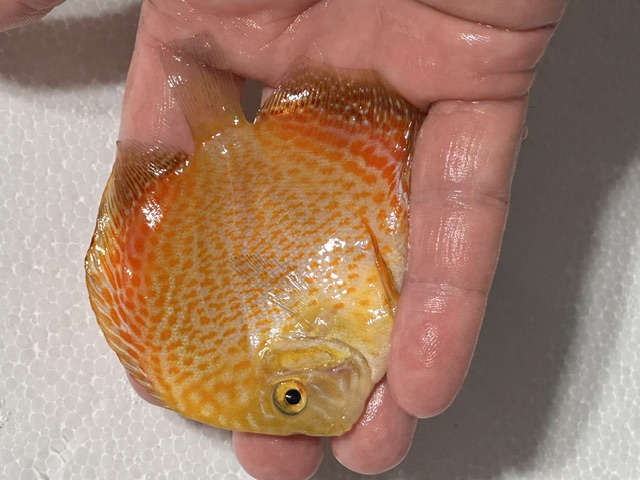
The name “Pigeon Blood” is derived from the deep red coloration of its eyes. Additionally, it is said that the term has historical roots in old Asian slang; “pigeon blood” referred to a reddish pigment, and the freckles (peppering) on the fish’s body gave the illusion of being splattered with this color
Breeding and Characteristics
Upon introduction, the Pigeon Blood Discus faced skepticism, with early specimens accused of being overly hormone-infused during competitions. However, despite this initial controversy, their striking appearance quickly gained popularity within the aquarium hobby. These fish are now recognized for their vibrant coloration and unique traits, such as a lack of vertical stress bars and beautiful peppering against a pale base color.
Over time, selective breeding has resulted in cleaner forms of Pigeon Blood Discus, with reduced black spots and enhanced coloration
Current Availability and Impact
Today, the Pigeon Blood Discus is widely available, with many variations and refinements resulting from ongoing breeding efforts. This strain has become foundational in the continued development of new discus colors, making it a significant feature in the aquarium hobby. Its unique genetic traits contributed to expanding the color spectrum and types of discus fish enjoyed by aquarists worldwide.